There’s a lot of misinformation out there about SNAP, but beyond the noise are real facts, real people, and real impact.
SNAP isn’t the problem, it’s part of the solution. The debate around SNAP is often filled with myths and distractions, but the reality is simple: SNAP is an essential part of our response to hunger in our communities.
Montana Food Bank Network is cutting through the noise by breaking down misconceptions, reducing stigma, and lifting up the real experiences of people who rely on SNAP across Montana. Explore this page to learn more about the reality of the program and push back against harmful misconceptions. Claims about fraud and misuse are not only largely unfounded, but they also reinforce harmful stereotypes about people with low incomes, overlook the real challenges families are facing, and distract from what really matters.
Hunger is the result of policy decisions and long-term underinvestment in our communities. It is not inevitable, and it does not happen because people aren’t working hard enough.
Affordability – not fraud.
A system that too often leaves people behind – not personal failure.

SNAP helps people put food on the table during tough or uncertain times, whether that’s between paychecks, during a job change, or when costs rise faster than wages. It works alongside other supports like school meals and food banks to help families stay afloat and avoid going without food.
For 1 in 14 Montanans, SNAP is the difference between skipping meals and getting through the month with dignity. It may not solve hunger on its own, but it’s an essential part of the solution.
SNAP Basics
What is SNAP?
The Supplemental Nutrition Assistance Program (SNAP), formerly known as the Food Stamp Program, is the nation’s most important anti-hunger program. In an average month in 2024, SNAP helped more than 81,500 Montanans afford a nutritionally adequate diet.
SNAP isn’t just helpful; it is a lifeline.
SNAP provides important nutritional support for working families with low-paying jobs, low-income older adults, people with disabilities living on fixed incomes, and other individuals and households with low incomes. In Montana, nearly 63 percent of SNAP participants are in families with children, nearly 38 percent are in households with older adults or people with disabilities, and nearly 82 percent of SNAP households had someone who worked in the last 12 months. After unemployment insurance, SNAP is the most responsive federal program that provides additional assistance during and after economic downturns.
Who is eligible for SNAP?
SNAP is broadly available to households with low incomes. SNAP eligibility rules and benefit levels are, for the most part, set at the federal level and uniform across the nation, though states have flexibility to tailor aspects. To qualify for SNAP benefits under Montana rules, a household must meet the following criteria:
- Its gross monthly income must be at or below 200 percent of the poverty line, or gross monthly income of $4,442 (about $33,576 a year) for a three-person household in 2026. Monthly income limits may be higher or may not need to be met for households that have a member who is over 60 or has a disability.
- Its net monthly income, or income after deductions, are applied for items such as shelter expenses (utilities and rent) and childcare, must be less than or equal to the 100% of the poverty line ($2,221 a month or about $25,652 a year for a three-person household in 2026).
- Some states have an asset test which means a household’s assets (such as funds in a bank account) must fall below certain limits. Montana does not have an asset test, however if the household has a member who is 60 or older or has a disability and did not meet the gross income test, the household can alternatively qualify under the federal program rules which have an asset limit of $4,500 but no gross income limit.
A SNAP household is generally made up of people who live together and purchase and prepare food together. Some people — such as individuals who are on strike, all people without a documented immigration status, some students attending college more than half time, certain people with drug-related felony convictions, and certain people with lawful immigration statuses — are not eligible for SNAP benefits regardless of how small their income or assets may be.
Most unemployed non-disabled adults aged 18 to 54 not living with minor children are limited to three months of benefits every three years, unless they are working at least 20 hours per week or participating in a qualifying workfare or job training program. States also have separate, broad authority to take away benefits from many adults who cannot meet or prove they are exempt from a work requirement.
How do people apply for SNAP?
Each state designs its own SNAP application process, following federal guidelines. In Montana, people may apply online, in person at their local Office of Public Assistance, or mail their applications. Applicants must participate in an eligibility interview, which can be on the phone or in person. They must also document numerous aspects, including their identity, residency, immigration status, household composition, income and resources, and deductible expenses.
Households must contact their Office of Public Assistance to report if their income changes. They also must reapply for SNAP periodically — for most families every six months and every 12 months for older adults and people with disabilities.
Households determined to be eligible receive an EBT (electronic benefit transfer) card, which is loaded with benefits monthly. Household members may use it to purchase food at one of the 785 retailers authorized in Montana. SNAP cannot be used to purchase alcoholic beverages, cigarettes, vitamin supplements, non-food grocery items such as household supplies, or hot foods.
How much do households receive in benefits?
The average SNAP household in Montana, will receive an estimated $173 per month (or about $5.70 per day) per person in regular SNAP benefits in fiscal year 2024. The minimum benefit amount in Montana is $24 per month.
To help households with the greatest need afford an adequate diet, the SNAP benefit formula enables households with the lowest incomes to receive larger benefits than households closer to the poverty line. The formula assumes that families will spend 30 percent of their net income on food; SNAP makes up the difference between that and the cost of the Thrifty Food Plan (TFP), a diet plan USDA established that is designed to be nutritionally adequate at a very low cost. A household with no net income receives the maximum benefit amount, which equals the cost of the TFP for a household of its size.

A Closer Look at Who Benefits from SNAP
In 2024, SNAP helped nearly 82,000 Montana residents have enough food to eat.
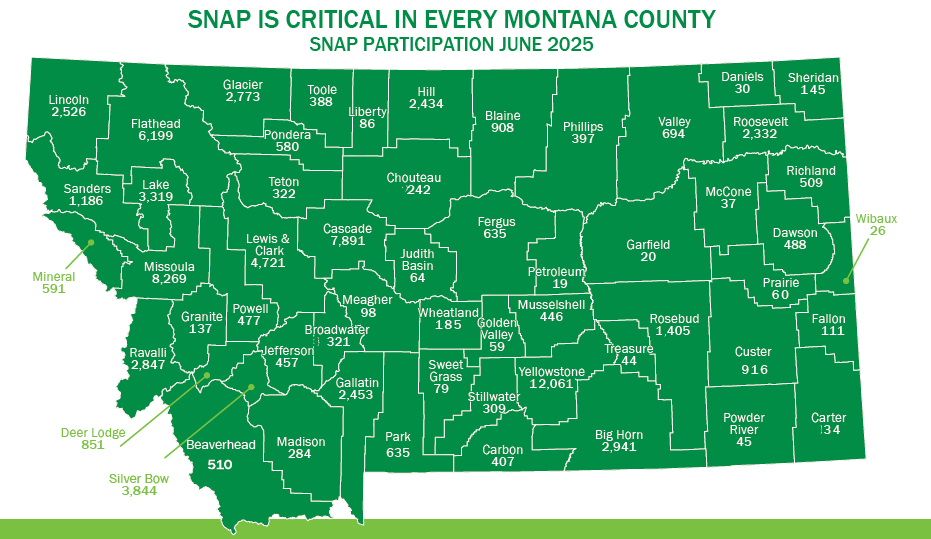
More Than Just Numbers: What SNAP Really Means
SNAP makes a real difference in people’s lives across Montana. It helps families keep food on the table and provides stability during uncertain times. These stories show what that impact actually looks like in everyday life.
“As a working single mom SNAP has helped me keep healthy food for my children. I often work 6-7 days a
week and still struggle to pay bills. With SNAP I am able to keep fresh fruits and veggies in stock at home.”— Elida, Beaverhead County
[SNAP] helps my mom out to get food on the table when my dad is working and it makes sure nobody goes to bed
hungry.— Aidan, Bighorn County

How Has H.R. 1 Really Impacted SNAP?
H.R. 1 takes a program that has long helped Montana families put food on the table and fundamentally weakens it. In a state where about 1 in 14 people rely on SNAP, this bill cuts federal support, shifts costs to Montana, and creates new barriers that will make it harder for people to access basic food assistance.
Dumps Federal Costs Onto States, Eviscerating SNAP’s Effectiveness
At the center of the bill is a major cost shift from the federal government to the state. Montana will be required to pay significantly more to run SNAP and could even be forced to cover a portion of the food benefits themselves if error rates are too high, costs that could reach tens of millions of dollars each year. These new financial burdens don’t come with new resources, meaning the state will likely face impossible choices: cut other essential services, reduce SNAP access, or both. This undermines SNAP’s long-standing role as a federally funded program designed to respond when people need help most.
Takes Food Away Through Harsh Rules and Eligibility Cuts
H.R. 1 also takes food assistance away from people who need it. The bill strips eligibility from many immigrants with legal humanitarian protections, including refugees and asylees—people who have long been recognized as eligible for support. At the same time, it dramatically expands harsh work requirements that have repeatedly been shown to push people off benefits without improving employment. Older adults up to age 64 and parents or caregivers of children 14 or older will now be subject to these rules, putting an estimated 12,000 Montanans at risk of losing some or all of their food assistance. These policies don’t address barriers to work like lack of childcare, transportation, or available jobs—they simply create more red tape and take food off the table.
Weakens SNAP’s Ability to Respond and Cuts Its Value Over Time
The bill also makes it much harder for Montana to respond to economic realities on the ground. By severely limiting the state’s ability to waive work requirements in areas with few jobs, H.R. 1 ignores the realities of rural economies and Tribal communities, where employment opportunities can be limited or inconsistent. Even during economic downturns, Montana may not be able to respond effectively, weakening SNAP’s role as a critical safety net.
At the same time, the bill quietly erodes the value of SNAP benefits for everyone who relies on them. By blocking future updates to how benefits are calculated, H.R. 1 ensures that assistance will fall further behind the real cost of food over time. Benefits already don’t stretch far enough, and this policy locks in that gap—effectively cutting food assistance more each year. Additional changes to how utilities are counted, including removing internet costs, will further reduce monthly benefits for many households.
Finally, the bill eliminates SNAP-Ed, a proven program that helps families make the most of their benefits, eat healthier, and stay active. Cutting this program removes practical support that helps people stretch limited food budgets and improve long-term health outcomes.
A Sweeping Rollback of SNAP With Real Losses Across Montana
H.R. 1 is not just a set of technical changes, it is a sweeping rollback of SNAP. It shifts costs to states, cuts people off assistance, reduces benefit adequacy, and adds unnecessary bureaucracy. The result will be more hunger, greater strain on Montana’s budget, and fewer tools to respond when communities face economic hardship.
Since H.R. 1s implementation in July 2025 to January 2026 we have seen a 7.29% decrease in SNAP participation.

SNAP is a practical effective program that helps people afford food during times when income doesn’t stretch far enough. Many people who use SNAP are working, raising families, or living on fixed incomes. It’s there for moments when wages fall short, hours are cut, or costs rise faster than paychecks. SNAP helps people stay on their feet, keep food on the table, and get through challenging periods with stability and dignity.
The real problem isn’t government spending, fraud, or mismanagement but the fact that people can be working a full-time job and still cannot afford to feed their families without the help of SNAP or food banks.
How Effective and Efficient is SNAP?
Before the federal government began providing nutrition assistance on a permanent basis in the late 1960s, hunger and severe malnutrition existed in many low-income communities in the U.S. In large part due to these assistance programs, such conditions are no longer found in large numbers today.
SNAP has one of the most rigorous eligibility determination systems of any federal benefit program. In addition, the SNAP quality control system requires states each month to select a representative sample of SNAP cases (totaling about 50,000 cases nationally over the year) and have independent state reviewers check the accuracy of the state’s eligibility and benefit decisions within federal guidelines. Federal officials then re-review a subsample of the cases.
USDA annually releases state and national payment error rates based on these reviews. When there are errors, the overwhelming majority result from honest mistakes by state agencies or participating households, not fraud. These error rates measure how accurately states determine eligibility and benefit amounts. States are subject to fiscal penalties if their error rates are persistently above the national average.
Quality control requirements were suspended in 2020 and 2021 due to the pandemic, so error rates were not established for those years. Error rates in 2022 were well above earlier levels, reflecting the ongoing challenges of the pandemic. Montana’s SNAP payment error rate in fiscal year 2024, the most recent year available, was 6.04 percent.
SNAP’s pandemic-related administrative flexibilities helped states process new applications and kept people connected to SNAP during a temporary time of severe economic challenges. However, these flexibilities, which were largely still in effect in 2022 and 2023, may also have contributed to higher error rates in some states.

In Montana, SNAP generated an estimated $254 million in economic activity in Fiscal Year 2024, helping keep money circulating in local communities across the state.
When people can afford food, they spend those dollars close to home. SNAP supports not just families, but also the businesses and jobs that communities rely on every day.
Special Features of SNAP
While SNAP’s fundamental purpose is to help low-income families, older adults, and people with disabilities afford an adequate diet, it also promotes other goals:
Protecting Families from Hardship and Hunger
Anyone who qualifies under SNAP program rules can receive benefits. Enrollment expands when the economy weakens, and contracts when the economy recovers and poverty declines. In this way, SNAP helps families to bridge temporary periods of unemployment or a family crisis. If a parent loses their job or has a low-paid job, SNAP can help them feed their children until they are able to improve their circumstances.
Studies show that SNAP benefits have reduced food insecurity for households with limited resources to purchase adequate food. Evidence shows that SNAP participation reduces food insecurity by as much as 30 percent and is even more effective among children and those facing very low food security — that is, a severe form of food insecurity characterized by disrupted eating patterns and reduced food intake.
As a result of the robust relief effort during the COVID-19 pandemic, food insecurity did not surge as it did during the Great Recession. The typical annual measure fell to a two-decade low of 10.2 percent in 2021. However, as those relief measures expired and food prices remained higher than they were before the pandemic, food insecurity rose over the next two years, to 13.5 percent in 2023.
Many households of color continue to disproportionately face food insecurity. In 2023, food insecurity under the annual measure remained at least twice as high for Black, Latinx, and Native American households, as they were for white, Asian, Native Hawaiian or Pacific Islander households. These inequities reflect the impact of structural barriers rooted in systemic racism, other forms of discrimination, and poverty, all of which make it harder for many people of color to afford food. These trends underscore that access to SNAP benefits continues to be critical in reducing households’ hunger and risk of food insecurity, as well as racial disparities in food insecurity.
Lessening the Extent and Severity of Poverty and Hardship
SNAP is a powerful anti-poverty tool. It provides resources for food, but also frees up household resources for other basic needs such as rent, utilities, or medical care. According to the most recent SNAP administrative data (from 2022), nearly 89 percent of SNAP benefits go to households with incomes at or below the poverty line, and 54 percent go to households at or below half of the poverty line.
A CBPP analysis using the government’s Supplemental Poverty Measure (which counts SNAP as income) and correcting for underreporting in government surveys found that SNAP kept nearly 6.6 million people above the poverty line before the COVID-19 pandemic, including 3 million children. A related CBPP analysis found that SNAP has one of the strongest anti-poverty effects of any program.
Supporting Workers in Low-Paying Jobs
SNAP benefits help fill the gaps for workers with low and inconsistent pay, including periods when they don’t have a job. Workers who participate in SNAP most commonly work in service or sales occupations such as aides or cashiers, which are often low paid and vulnerable to income volatility.
SNAP benefits phase out slowly with increased earnings. This means that for most SNAP households, the program continues to serve as an income support — making it easier for families to afford food — as they earn more and work toward financial stability.
The share of SNAP households with earnings has grown over the past three decades. Work rates have risen among all SNAP households over time, but especially among households with children. This overall trend continued despite the large job losses during economic downturns.
Most SNAP participants who can work do so. 82% of SNAP households in Montana have had a worker in their household in the last 12 months. More than two-thirds of SNAP participants are not expected to work, primarily because they are children, older adults, or disabled people.
Supporting Healthy Eating and Improved Health
SNAP enables low-income households to afford more healthy foods and boosts families’ food purchases, particularly those to be prepared or eaten at home.
A substantial body of recent research links SNAP with improved health outcomes and lower health care costs. Several studies also show a relationship between SNAP participation and reduced health care expenditures. Additionally, research on the nationwide expansion of food stamps in the 1960s and ’70s finds that children born to women with low income in counties that had implemented food stamps had better health outcomes as adults than those born in counties that had not yet implemented the program.
Protecting The Overall Economy
SNAP benefits are one of the fastest, most effective forms of economic stimulus because they get money into the economy quickly during a recession. Individuals with low incomes generally spend all their income on daily needs such as shelter, food, and transportation. This means that every dollar in SNAP that a low-income family receives enables them to spend an additional dollar on food or other items. Nearly 78 percent of SNAP benefits are redeemed within two weeks of receipt and 96 percent are spent within a month, based on data from 2017.
According to a 2019 USDA report, every dollar in new SNAP benefits increases GDP by $1.50 in a weak economy. In fiscal year 2024 SNAP generated nearly $254 million in Montana’s state and local economies. Similarly, CBO and Moody’s Analytics have each found that SNAP has one of the largest “bangs-for-the-buck” (i.e., increase in economic activity and employment per budgetary dollar spent) among a broad range of policies for stimulating growth and creating jobs in an economic recession.
Responding Quickly to Natural Disasters
In the wake of natural disasters, SNAP provides critical food assistance to vulnerable households. USDA and states work together to provide quick, targeted assistance after disasters. This can include replacing participants’ benefits to compensate for lost food, providing temporary Disaster SNAP benefits to non-participants who have suffered significant loss, and relaxing program requirements to ease access and relieve undue burden on staff.
Food should not be a luxury… it should be a right.
All data and information sourced from USDA Food and Nutrition Service | Food and Nutrition Service, United States Department of Agriculture, Center on Budget and Policy Priorities, and Montana Department of Health and Human Services.